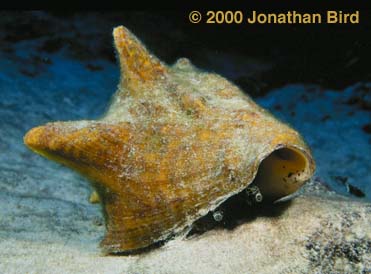
Mollusks are an amazingly diverse group of animals that live in a wide variety of environments. They can be found inhabiting trees, gardens, freshwater ponds and streams, estuaries, tidal pools, beaches, the continental shelf, and the deep ocean. Some mollusks are excellent swimmers; others crawl or burrow in mud and sand. Others remain stationary by attaching themselves to rocks, other shells, or plants; or by boring into hard surfaces, such as wood or rocks. Adult mollusks can range in size from a few mm (0.1 in.) to over 22 m (>70 ft.) in length as documented for some giant deep-sea squids. Their weight can vary from a few mg (a fraction of an ounce) to over 227 kg (500 lb.) as recorded for the giant south Pacific Tridacna clams.
Fossil Mollusks
Mollusks first appear in the fossil record about 545 million years ago in earliest Cambrian time, but the record of their origin and early evolution has not been discovered in the fossil record. By late Cambrian time (~520-505 million years ago) most of the modern groups of mollusks can be found in some primitive form as fossils occurring in marine deposits. During the Ordovician (~505-438 million years ago) a major radiation of mollusks occurred, with thousands of species of mollusks appearing in the fossil record of that time.
During the Mesozoic (~245-65 million years ago) the ammonites, a relative of the modern chambered nautilus, flourished and are an important part of the fossil record, but they became extinct at the end of the Cretaceous at the same time as the dinosaurs. Many types of clams and snails also disappeared at the end of the Cretaceous, including the rudists, a group of bivalved mollusks that lived much as modern reef-building organisms do. The disappearance of these marine animals opened up environmental niches to be filled by a radiation of new species of all types of animals at the beginning of the Cenozoic.
The Cenozoic (beginning around 65 million years ago to the present) marks the time period when the modern groups of mollusks evolved, beginning with the marine clams and snails following the end of the Mesozoic. During the last million years land and fresh-water mollusks have evolved rapidly, occupying the terrestrial realm to an extent never seen in their fossil record.

No comments:
Post a Comment